

Top 5 Business Applications
You Can Build with Oracle APEX?
From ERP and HR systems to CRM, inventory, and compliance dashboards — discover the most impactful enterprise applications you can build with Oracle APEX.
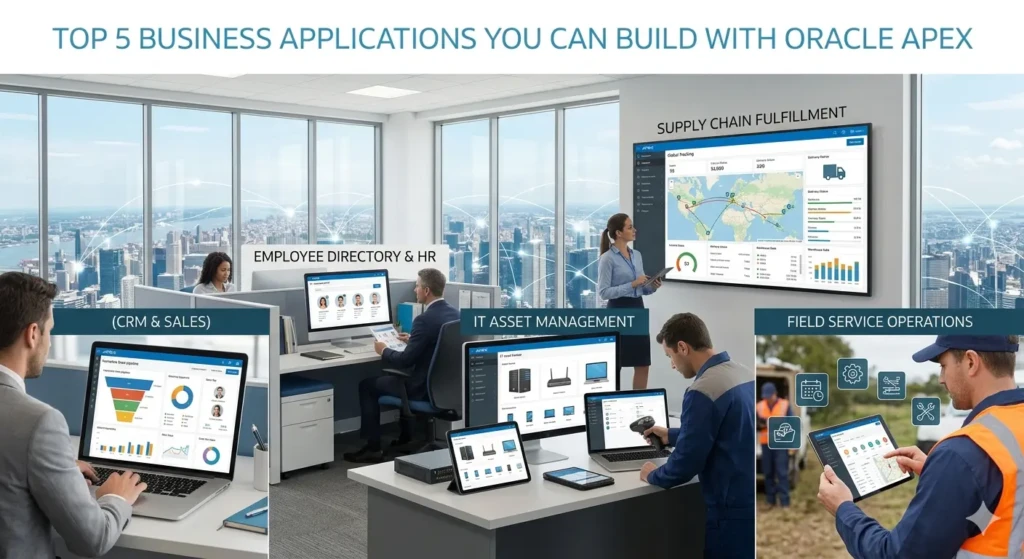
Introduction
Oracle Application Express (APEX) has quietly become one of the most powerful low-code platforms in enterprise software. With decades of evolution baked into a browser-based IDE sitting directly on top of Oracle Database, APEX lets developers build sophisticated, data-rich business applications in days — not months.
Unlike generic low-code platforms that abstract away the database, APEX runs natively inside Oracle Database. That means your application logic, your data, and your security controls all live in the same engine — eliminating network latency between the app tier and the database, and leveraging Oracle's battle-tested performance and security infrastructure.
APEX ships with over 100 pre-built UI components, tight integration with Oracle REST Data Services (ORDS), support for JavaScript frameworks, and built-in progressive web app (PWA) capabilities. The result is a platform that scales from a quick departmental tool all the way to a mission-critical application serving thousands of concurrent users. Now, let's look at where businesses are putting this platform to work.
1 Enterprise Resource Planning (ERP) & Financial Management Systems
ERP & Financial Management
Custom-built on Oracle Database — the same engine powering Oracle E-Business Suite and Oracle Financials
Perhaps the most natural home for an Oracle APEX application is a custom ERP or financial management system. Most organisations outgrow spreadsheets but find commercial ERP suites bloated, expensive to license, and rigid in customisation. APEX bridges that gap with precision.
Because APEX sits on top of Oracle Database, a custom-built APEX ERP can read, write, and report on the same tables used by enterprise systems without any data migration. This makes it ideal for extending an existing ERP with custom modules, or building a lean ERP from scratch for mid-market organisations.
Key capabilities you can build:
APEX's declarative Interactive Reports and Interactive Grids turn complex financial data into pivot-ready, exportable tables without writing a single line of front-end code. Plug in Oracle Analytics Cloud via REST APIs, and your finance team gets self-service BI on top of live transactional data.
Organisations that build custom APEX financial modules report a 40–60% reduction in report generation time compared to legacy systems, thanks to APEX's native SQL processing that skips the middleware layer entirely.
2 Human Resources Management & Employee Self-Service Portals
HR Management & Self-Service Portals
Complex workflows, strict role-based security, rich reporting, and a polished user experience — all APEX strengths
HR applications are a sweet spot for Oracle APEX because they demand complex workflows, strict role-based security, rich reporting, and a polished user experience — all areas where APEX excels. From recruitment to retirement, the entire HR lifecycle can be managed within a single APEX application suite.
An APEX-built HRMS can handle everything from onboarding new hires — automatically provisioning accounts, sending welcome emails via APEX_MAIL, and routing equipment requests — to performance management cycles where managers submit 360-degree reviews, goals cascade through reporting hierarchies, and employees access their own performance history through a clean self-service portal.
Key capabilities you can build:
APEX's built-in authentication can integrate with Oracle Identity Cloud Service, Active Directory via LDAP, or SAML 2.0 identity providers — meaning employees log in with their existing corporate credentials. The progressive web app capability means the self-service portal works seamlessly on mobile without building a separate native app, saving significant development and maintenance cost.
Commercial HR platforms charge per-seat licensing that escalates rapidly. An APEX-built HR portal, hosted on an existing Oracle Database licence, eliminates per-user SaaS fees entirely. For a 500-person organisation, this translates to substantial annual savings in avoided software costs.
3 Customer Relationship Management (CRM) & Sales Pipeline Tools
Custom CRM & Sales Pipeline
Tailored to your exact sales process, territory, pipeline stages — with live order, invoice, and delivery data in one view
While Salesforce dominates the CRM market, many enterprises find themselves paying for features they never use while lacking functionality specific to their industry. Oracle APEX makes building a tailored CRM not just feasible but genuinely advantageous — especially when customer data already lives in an Oracle Database alongside orders, invoices, and support tickets.
A custom APEX CRM can be designed around your exact sales process: your terminology, your pipeline stages, your custom fields. It can surface insights that a generic CRM never would — for example, automatically flagging accounts whose order frequency has dropped, or calculating predicted lifetime value based on historical purchase patterns using in-database analytics.
Key capabilities you can build:
APEX's Map region can plot customer locations geographically, making territory management visual and intuitive. Using APEX_WEB_SERVICE or native REST integration, the CRM can push and pull data from third-party tools like Mailchimp, Twilio SMS, or WhatsApp Business APIs — giving sales teams a truly unified view of every customer touchpoint.
Because the CRM lives in the same database as your order management and finance systems, there is no ETL pipeline, no nightly sync, and no risk of stale data. Sales reps see live account balances, open invoices, and delivery statuses right inside the CRM — a capability that typically requires expensive middleware in competing platforms.
4 Inventory Management & Supply Chain Visibility Platforms
Inventory & Supply Chain Visibility
Real-time data accuracy, complex multi-location logic, and fast reporting across millions of rows — Oracle Database's native strength
Inventory and supply chain applications demand real-time data accuracy, complex multi-location logic, and fast reporting across millions of rows — this is precisely what Oracle Database was built for, and precisely why APEX is such a natural fit for this domain.
An APEX-built inventory system can manage warehouses, track goods from purchase order through goods receipt, quality inspection, binning, picking, packing, and despatch — all within a single application. Barcode scanning can be implemented via APEX's PWA camera APIs, allowing warehouse staff to scan items on mobile devices without additional hardware drivers or native app development.
Key capabilities you can build:
Oracle's analytic functions — LAG/LEAD, LISTAGG, window functions — make it trivially easy to compute moving averages for demand forecasting, identify seasonal patterns, or calculate safety stock levels. All of this executes in-database at speeds that client-side BI tools cannot match.
Industries like pharmaceuticals, food & beverage, and electronics require batch-level traceability for regulatory audits. APEX can present a complete forward and backward trace of any batch — from raw material supplier through to end customer — in a single page, generated from Oracle's powerful CONNECT BY hierarchical queries in under a second.
5 Regulatory Compliance, Audit Management & Executive Dashboards
Compliance, Audit & Executive Dashboards
Centralise ISO, SOC 2, GDPR, and industry-specific compliance processes with a tamper-evident, fully auditable system
Every organisation above a certain size has compliance obligations — whether it's ISO certifications, internal audits, ESG reporting, GDPR data-subject request management, or industry-specific regulations like RBI guidelines for banks or CDSCO requirements for pharma companies. These processes are often managed in spreadsheets and email chains, creating unacceptable audit risk. Oracle APEX can centralise and formalise them elegantly.
A compliance management application built in APEX can define control frameworks, assign control owners, schedule evidence collection tasks, record observations and non-conformances, and generate audit-ready reports — all with a complete, tamper-evident history stored in Oracle's database. Unlike a spreadsheet, every change is timestamped, every approval is logged, and every document attached is stored securely.
Key capabilities you can build:
Oracle APEX's Faceted Search and Interactive Report regions allow auditors and executives to slice compliance data in real time — filtering by business unit, risk category, control owner, or date range without leaving the browser. The built-in PDF printing capabilities mean audit reports can be generated directly from the application, formatted and branded, without any external reporting tool.
Executive dashboards in APEX can aggregate KPIs from across an enterprise — financial performance, operational metrics, HR headcount, customer satisfaction scores — into a single, visually coherent view. Using APEX's native chart engine (Oracle JET), data refreshes automatically on configurable intervals, so leadership always sees live numbers, not yesterday's export.
Oracle Database's Unified Auditing and APEX's built-in application change tracking together provide a forensic-grade audit trail that no spreadsheet-based compliance tool can match. Demonstrating who changed what, when, and why becomes a one-click report rather than a manual investigation.
Conclusion
The five application categories above share a common thread: they all require complex data relationships, strict security, workflow automation, and reporting depth that generic tools struggle to deliver — and that commercial packaged software delivers only at high licensing cost and low customisation flexibility.
Iqra Technology — Your Oracle APEX Expert Partner
Oracle APEX occupies a genuinely distinctive position — and it is one that Iqra Technology has built deep expertise around. It is not a drag-and-drop toy that tops out at simple CRUD screens, nor is it a full-stack framework that demands a team of React and Node.js developers. It sits in a productive middle ground: a declarative, SQL-first platform where Iqra Technology's skilled developers build production-grade enterprise applications in weeks, not quarters, with a fraction of the infrastructure overhead that traditional web application stacks require.
If you are ready to get started, our professional Oracle APEX Application Development Services help you scope, architect, and deliver the right solution for your business — faster than you might expect. As APEX continues to evolve — with each release adding AI integration through Select AI, improved REST API tooling, enhanced PWA capabilities, and tighter integration with Oracle Cloud Infrastructure — Iqra Technology stays ahead of every one of those advancements.
The fastest path to value is to Hire an Oracle APEX Developer from Iqra Technology — professionals who bring hands-on experience with the platform's full capabilities, from PL/SQL backend logic to polished, responsive front-end components. No learning curves. No guesswork. Just expertise that delivers.
The best Oracle APEX application is the one that solves your specific problem, speaks your business's language, and runs on infrastructure you already own. With the right requirements and Iqra Technology's expertise behind you — that application is closer than you might think.
